From here on, you will be linked to Nomura Co., Ltd. 's partner page. You can apply from the list of available positions at the link. (Please note that CIC may not always be recruiting.)
![CIC [Content Integration Center] Fantasy Implementation Group](/wp-content/uploads/2024/10/ciclogo-w.svg)


CIC NOTE
2026.02-19
Aya Watanabe
Text: Aya Watanabe Illustration: Masahiro Yamagishi
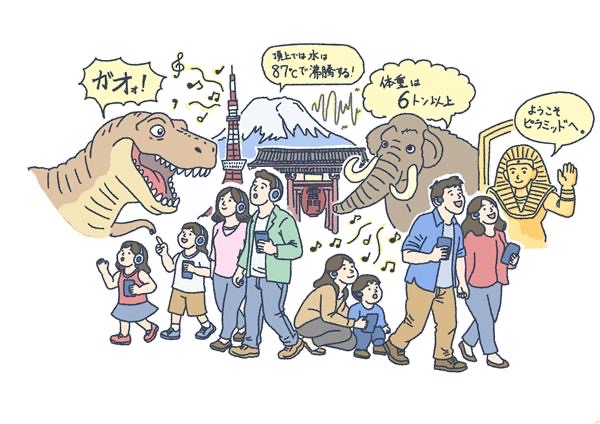
We are Watanabe and Yamagishi from the UX Design Department. We usually start with digital content and work on planning experiences for the entire space, as well as directing the production of content such as videos and applications.
This may be a bit sudden, but have you ever used services such as "audio guides," "digital guides," or "exhibition guides" at museums or tourist spots?
This service, which can be used in a variety of formats such as smartphones and dedicated devices, allows users to listen to explanations tailored to their needs while viewing the exhibits, and has the function of promoting a more enjoyable and deeper understanding in a storytelling-like format, and has been introduced to many facilities.
In recent years, there have also been many examples of interactive functions that use technologies such as image recognition, AI, and location information. These are no longer just a function to supplement the explanation of an exhibit, but are instead seen as a method for promoting a theme in a space, with the exhibit at the center, and in some cases are planned and produced as one of the elements that make up an exhibition.
At Nomura Co., Ltd., as a creator responsible for producing spaces that attract customers, we implement thematic appeal through a variety of channels centered on the space in the form of "audio guides" and "digital guides."
Yamanashi Prefectural Mount Fuji World Heritage Center
この記事では、日々の業務で扱う手法を定期的にゆっくり見つめ直したい!と思うこともあり、音声再生機能限らない機能も含む、課金制を伴う音声ガイドサービスについて調査を行いました。
今後も空間における集客効果を高めるひとつの切り口として、「音声ガイド」というサービスの在り方について調査し、その結果と今後の期待について触れていきます。
In a survey of 120 employees of Nomura Co., Ltd., a company specializing in spatial creation, approximately 70% of respondents said they had used an audio guide that required payment.
Additionally, we asked them to answer questions 1 and 2 below.
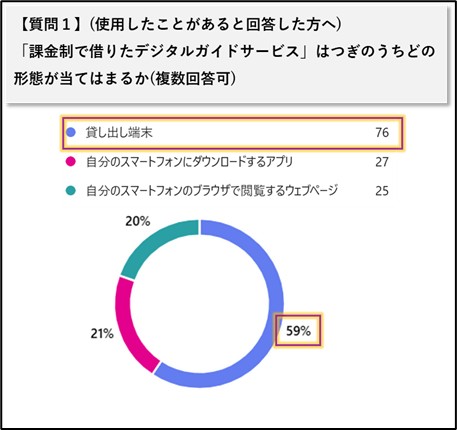
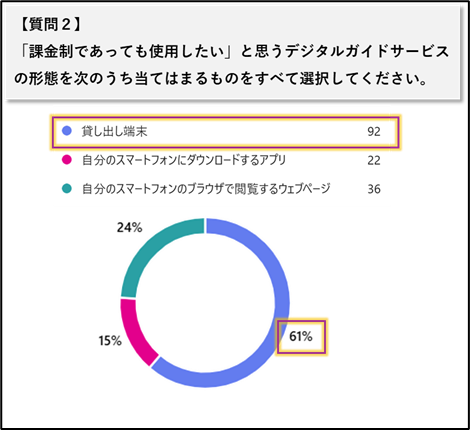
The survey results showed that of those who have used a paid audio guide service, approximately 60% used a guide system that uses a "rented device." Furthermore, when asked which digital guides they would be willing to use even if they were charged, approximately 60% chose "rented device." Both questions offered the answer options of "rented device" or "using a device owned by the user," but it is notable that the majority of answers to both questions were focused on "rented device."
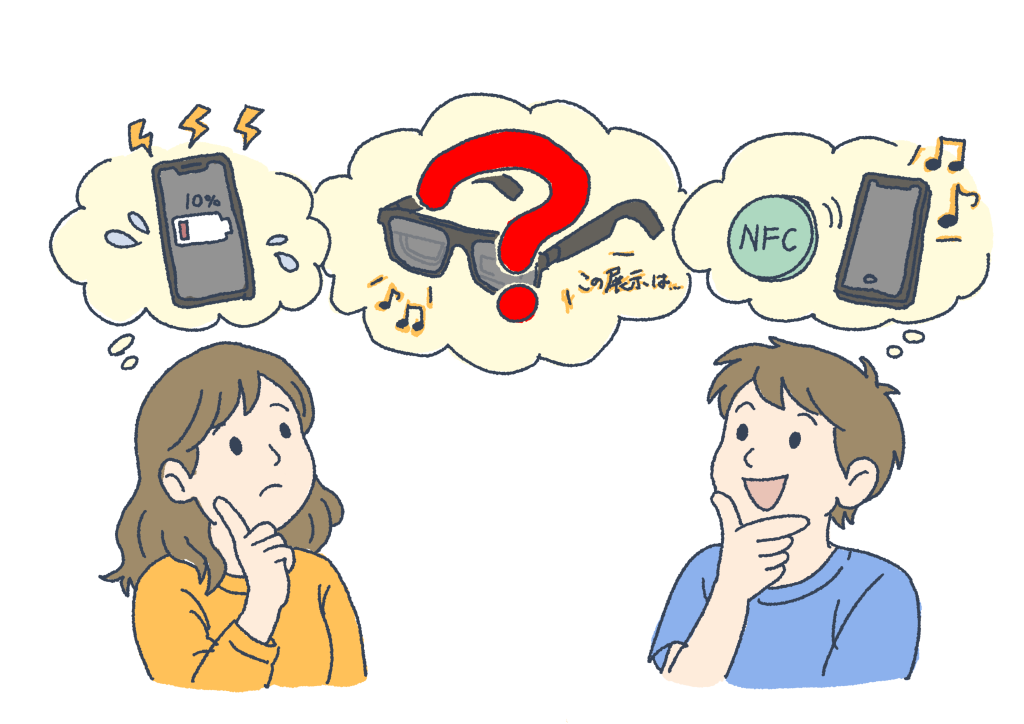
Based on the survey results, we would like to highlight the possibility that factors other than the use of physical devices may be driving service usage.
For example, while a owned device may not have sufficient or sufficient specifications, or may have some inconveniences such as battery or network connection issues, a rental device can be used without any problems from the moment it is rented, providing the shortest access distance. It is also possible that the special feeling of an experience that can only be experienced in this place and at this moment is what encourages people to pay.
The survey allowed us to receive a wide range of opinions about audio guides in a free-form format.
"I want something that allows me to select guidance with simple operations and has a cool design."
"One guide used bone conduction, which was comfortable to hear, hygienic, and not noisy."
While there are cases where the design of the device, ease of operation, and ability to use the device appropriately in the viewing environment are evaluated,
"It would be great if the audio would play naturally when you approach the content."
"I want to see my current location on an interactive map and get suggested itineraries."
Some people expressed their hopes for more practical use of audio guides using specific technologies such as:
Audio guides are used in a variety of environments, and providing an appropriate experience for each situation is believed to increase satisfaction with the overall spatial experience.
The survey results showed that the minority view of "using personal smartphones and other devices" is available at a variety of price points, including free, and allows users to operate their own devices with ease as an extension of their daily routine. Furthermore, for businesses, this approach does not involve physical lending or borrowing, which may reduce the risk of loss or theft and the costs of managing devices.
On the other hand, creating content for rental devices allows for greater freedom in design because the device's technical functional limitations can be relatively minimized, making it possible to create content that is more closely linked to spatial experiences. This is an attractive feature, but it may also increase users' satisfaction by allowing them to enjoy the content more. Such services may also be remembered by users as "special experiences."
In this survey, we looked at paid audio guides, but it would be good to adopt the appropriate method depending on the situation.
Once again, thank you to everyone who participated in the survey and provided your valuable feedback!
This survey touched on the potential for fee-based audio guide services to provide value beyond supplementary explanations of exhibits. Making full use of every touch point seems to have the potential to maximize the appeal of the space's themes.
It was an opportunity for us to think that the space we are working on and the services and functions that exist therein should transcend the physical space and continue to be a constant process of trial and error, so that the spatial experience we create is gentle and satisfying for everyone, not just our target audience.
Incidentally, the idea for this survey started when, while researching audio guide services, I thought, "Let's ask a spatial professional about spatial matters!" The journey of trial and error continues, trying all sorts of methods. If you're interested, let's talk!