From here on, you will be linked to Nomura Co., Ltd. 's partner page. You can apply from the list of available positions at the link. (Please note that CIC may not always be recruiting.)
![CIC [Content Integration Center] Fantasy Implementation Group](/wp-content/uploads/2024/10/ciclogo-w.svg)


CIC NOTE
2026. 02-02
Fumiaki Tanaka
CIC NOTE
Fumiaki Tanaka 2026.01.12
Title: Example of a spatial designer's thinking pattern
My name is Fumiaki Tanaka from CIC's Creative Direction Department.
In recent years, I have been fortunate enough to be involved in an increasing number of large-scale projects. As a result, it has become increasingly difficult to collect ideas by simply coming up with one-off ideas, and I have been troubled by the contradictory requirement of spreading ideas while also anticipating the outcome. I would like to introduce a thought pattern as a spatial designer that covers everything from conception to completion, which may provide a clue to resolving such situations.
<New ideas from combining elements>
Nomura Co., Ltd. Ltd. has previously collaborated with another company to develop an idea generation support tool called the "Inspiration Engine." This system generates the seeds of unexpected ideas by randomly combining trending words extracted in real time with pre-set words and visualizing them one after another.
When trying to come up with new ideas, like this "inspiration engine," combining different elements is a common idea generation method used by everyone reading this, including designers. I am one of them, and I often use this method in the early stages of planning and design.
First, I will explain the process I use to gather ideas from the idea patterns I use in the basic concept stage of spatial design, which requires new ideas.
<Identifying guest emotions and experience elements>
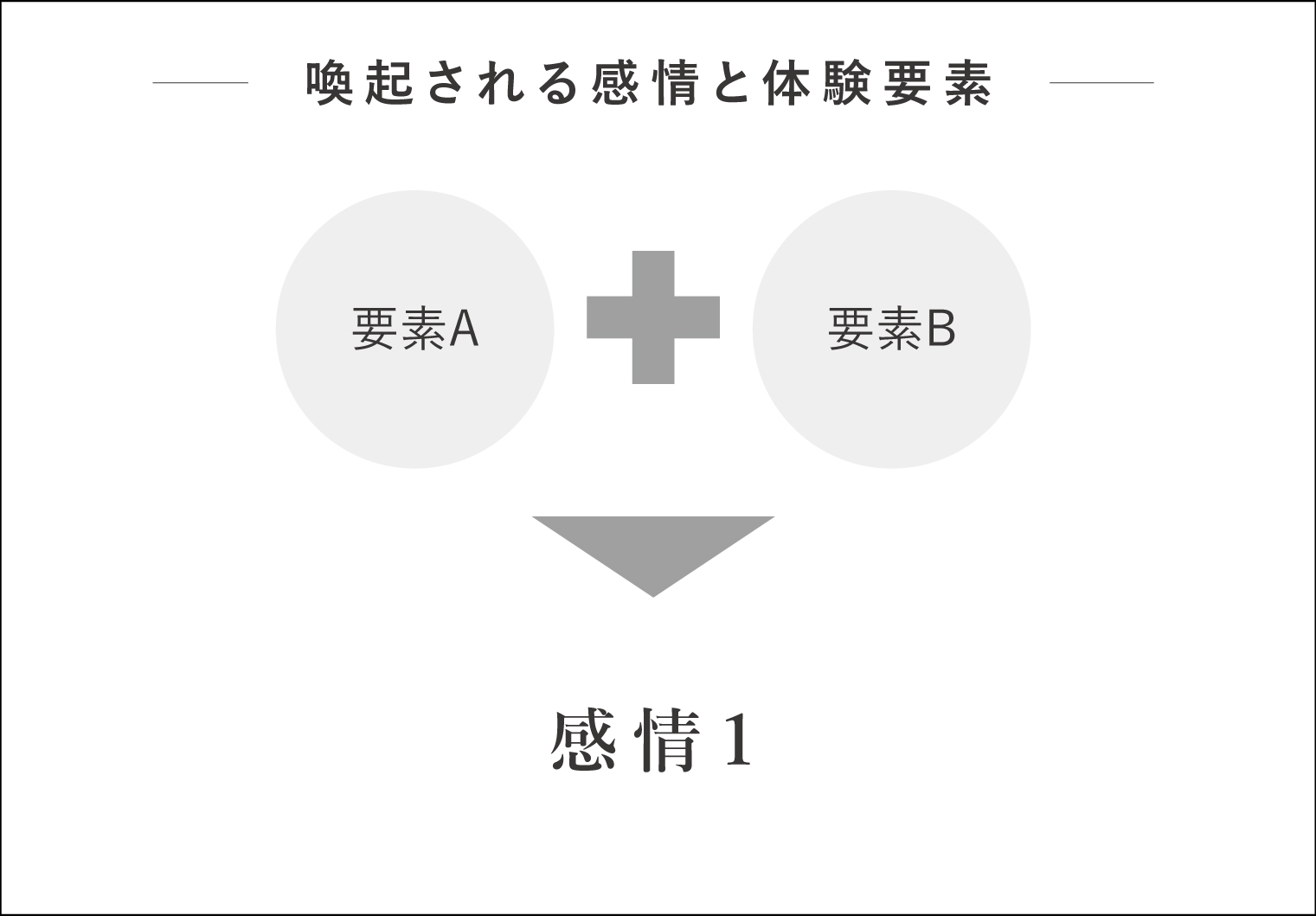
In my case, I consider two "experiential elements" that will bring about specific "emotions" in guests, as shown in Figure 1. If I create a space with a combination of unprecedented experiential elements to evoke emotions that can only be felt in this space, I believe it will provide a sense of freshness, surprise, and unexpectedness, and provide experiences and emotions that are not predictable.
Figure 1: Multiplying two elements
However, the world of spatial design is not so simple that it can be called a novel idea. Spatial design does not end with simply envisioning one emotion. There are multiple emotions that a single facility should evoke in guests, such as the sense of anticipation when approaching the facility, the sense of the extraordinary the moment you enter, the emotions evoked by the experience itself, the lingering feeling after the experience, and the excitement that returns when you look back and talk about it with someone. Furthermore, in addition to the main space, secondary spaces such as restrooms, coin lockers, and waiting areas are also essential components for making the experience more memorable and comfortable.
In the basic concept stage of a space, it is necessary to identify these secondary emotions, experiences, and spatial components as well. However, if we seriously consider these, it will look like Figure 2.
Figure 2: Listing the emotions and experience elements evoked
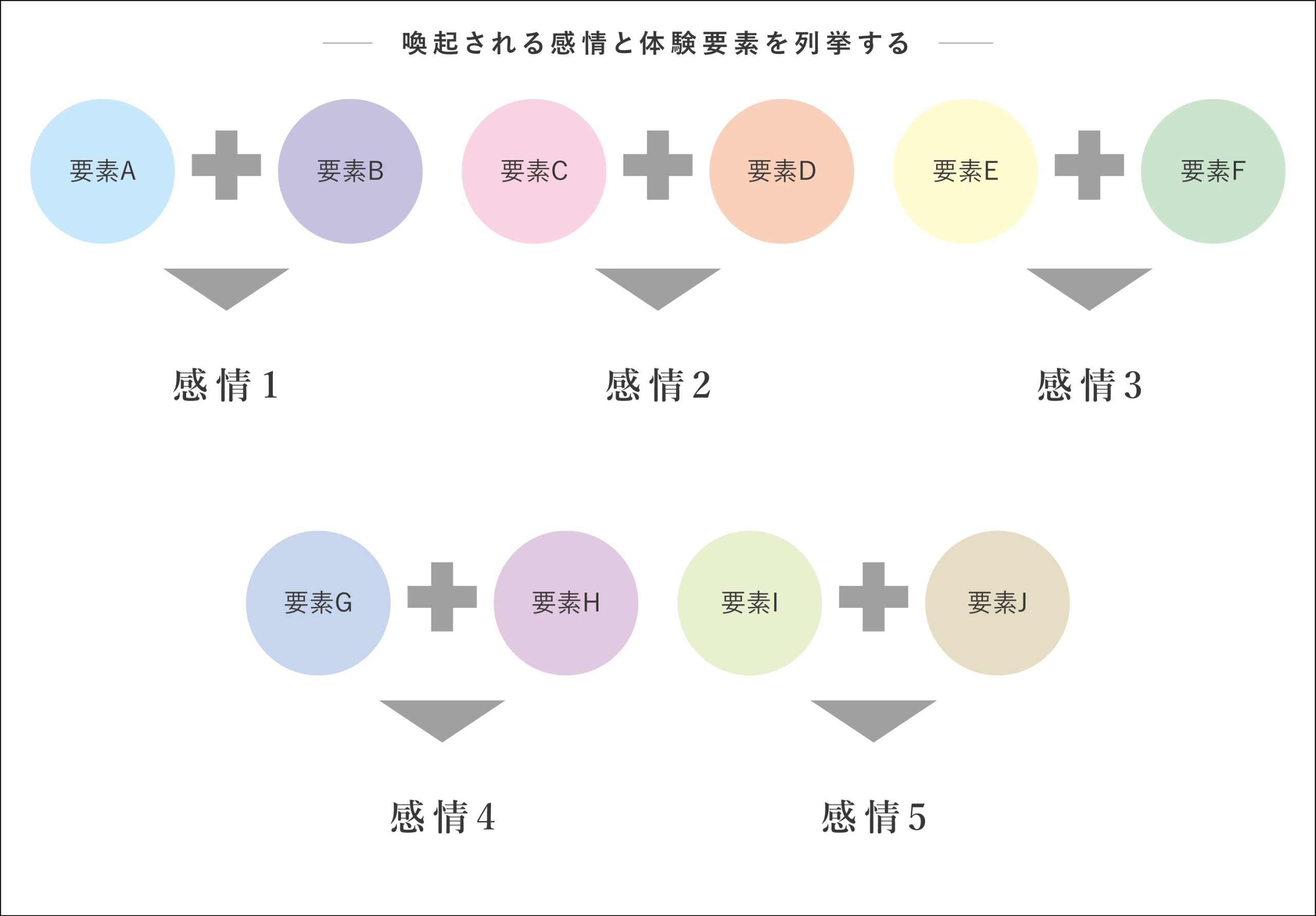
Frankly speaking, this process of identifying the issues is exhausting. If I were to submit a proposal in this state, wouldn't the person receiving the proposal be annoyed and ask me to simply say it in one sentence? (laughs)
In this way, simply listing the emotions and elements that you want guests to experience makes it difficult to create a sense of unity throughout the facility or a sense of story, and the space will leave guests with only a vague impression that "there were a lot of different things."
Furthermore, the more proposals you submit, the more complex the design becomes, the more specialists are involved, and the higher the cost and delivery time... As a result, not only is the proposal less attractive, but it also becomes less feasible. You must convert and organize them into a form that is appealing and highly feasible.
<Consolidation of experience elements and circular structure>
This is where there is room to create a highly original space that cannot be imitated by others, and I believe this is the time when spatial designers can feel the rewards of their work. From here, I will explain the process of consolidating the scattered ideas.
As shown in Figure 3, we reduce the number of experience elements that share adjacent emotions by combining them. We organize and classify the emotions that are evoked in accordance with the experience story, and consolidate them while maintaining diversity so that the overall experience elements create synergy as much as possible.
Figure 3: Evoked emotions and experiential elements 1
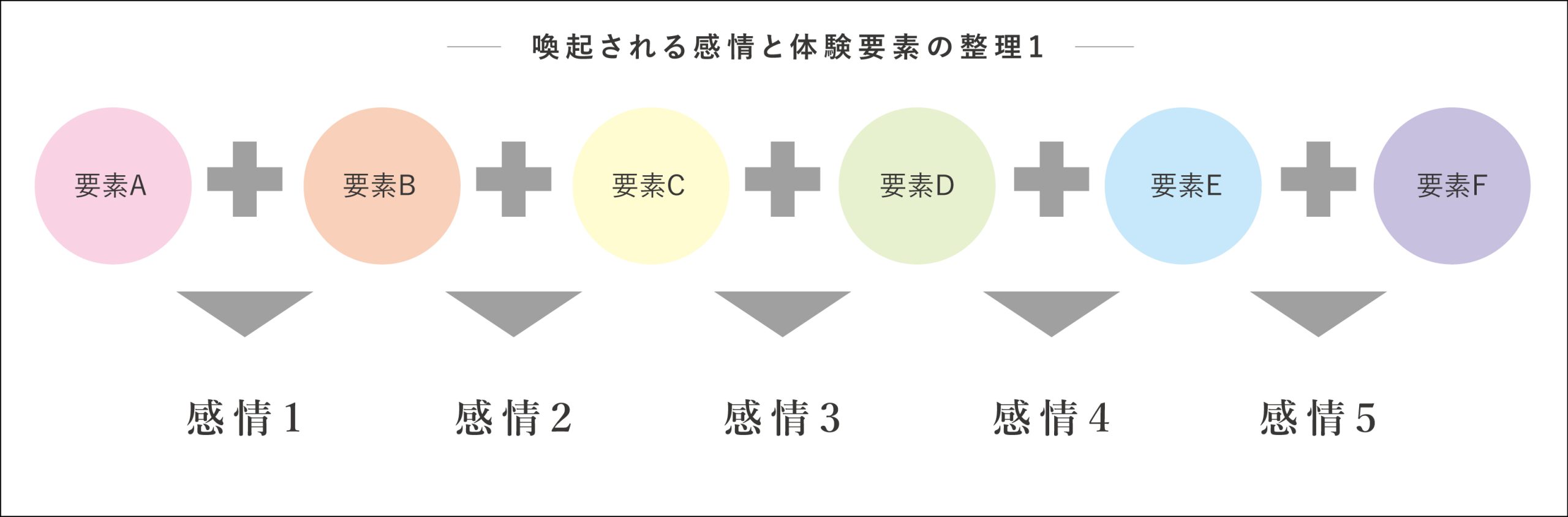
This is sufficient as it is, but if we try to continue like this, people are greedy, and as the project progresses, they will want to add more elements G, H, etc. Therefore, in order to solidify the overall image of the facility (and make the proposal more concise), we will share both ends of the experience elements, as shown in Figure 4.
Figure 4: Evoked emotions and experiential elements 2
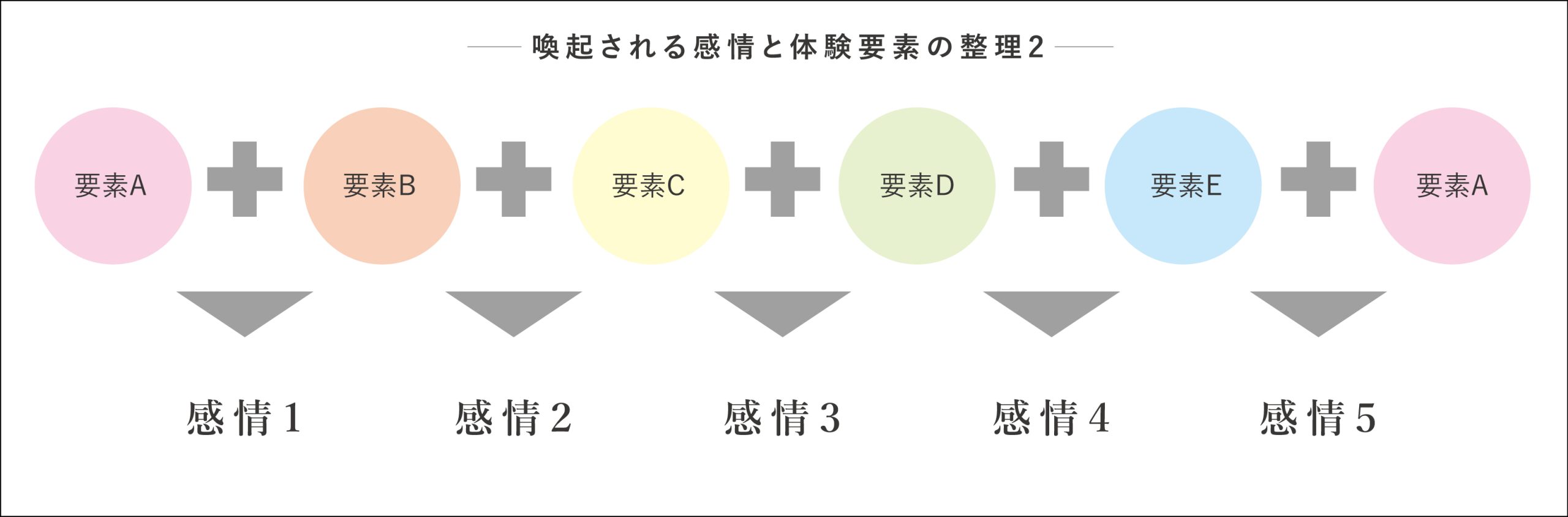
This will put an end to the endless generation of ideas. If you organize this into a diagram, it will become a single, connected block, as shown in Figure 5.
Figure 5: Image of a ring
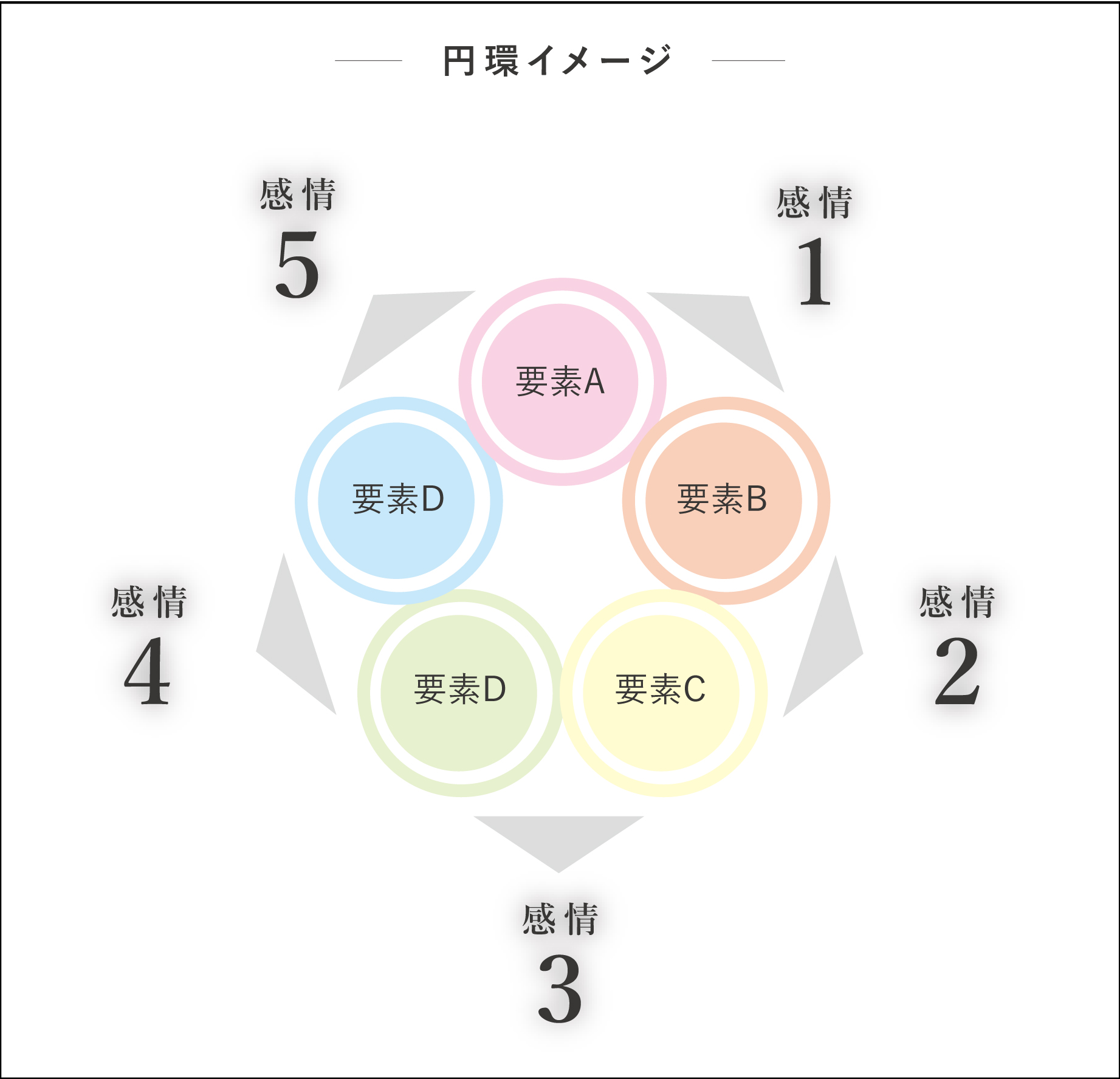
By doing this, the whole space can be consolidated into five different elements, and it looks like a cohesive space can be created. By the way, this is a task of organizing the elements, so it does not correspond to zoning or floor plans, etc., so those tasks will need to be carried out separately.
<Application example for entertainment facilities>
Terms like "Emotion 1" or "Element A" may not be very clear, so from here on, I will use examples I have used in past proposals, rearranged for this article, to give concrete examples. I will use "entertainment facilities," which I have been in charge of a lot in recent years, to give more concrete meaning to the terms. The purpose of this example is to ask, "What elements are required for an entertainment facility?"
Let's assume that.
Of course, "wow" is essential for an entertainment facility. A "sense of accomplishment" is also essential as a reward for going out of your way to visit, and a "sense of unity" that can be shared with others. I also like to create spaces that evoke emotions such as "chill" and "ecstasy." If we list just these emotional aspects, we get Figure 6.
Figure 6: Emotions evoked and experiential elements (in the case of entertainment facilities)
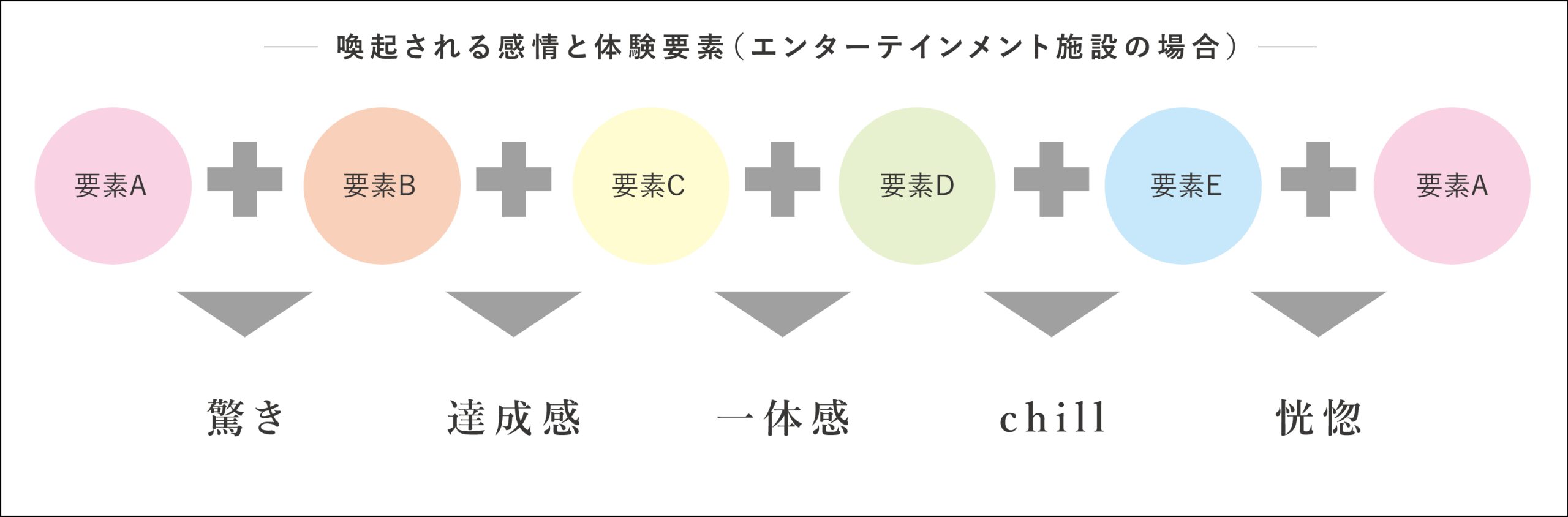
Now, we start brainstorming by asking ourselves, "What are the experiential elements that will evoke these feelings?" In this process, we often collect images on sites like Pinterest, and then use the KJ method to come up with words that symbolize them. These words usually refer to playful elements, production techniques, spatial elements, materials, food and drink, etc. In this example, we start with visual production, which has become indispensable in recent years, and organize multiple elements and emotions to create the final product, as shown in Figure 7. In some cases, the words that express emotions may be revised after all the experiential elements have been identified.
Figure 7: Emotions evoked and experiential elements (in the case of entertainment facilities)
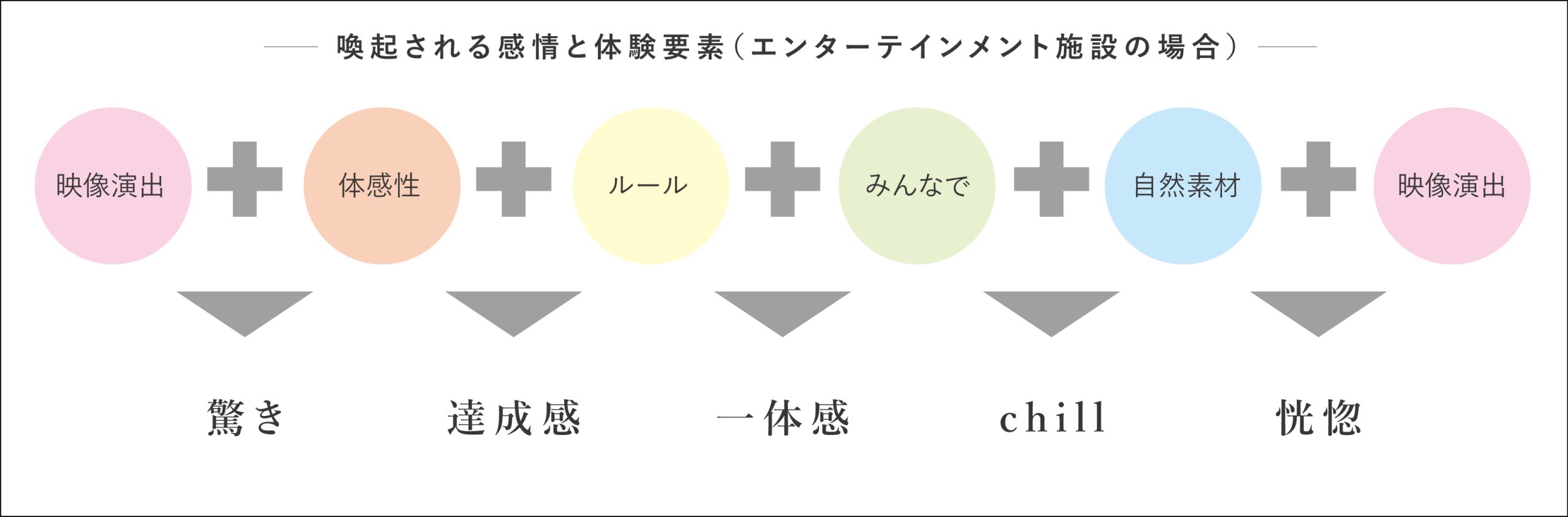
Since trying out this idea pattern, I have been having fun each time, filling in each emotion and element with more specific words than in this example. The number may increase or decrease. If we make this into a circle, it looks like Figure 8.
Figure 8: Image of a circular ring (entertainment facility)
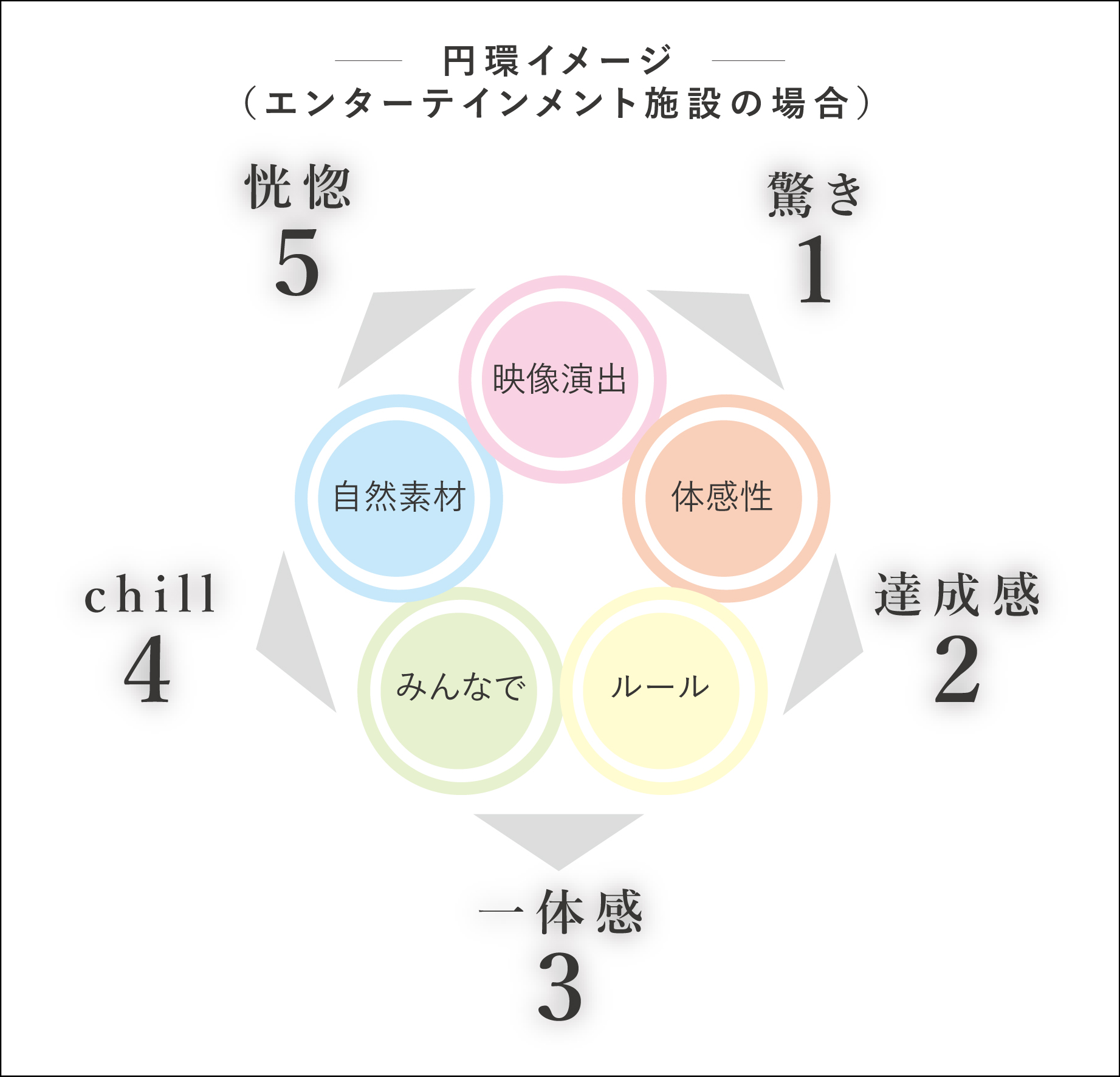
Once we've sorted this out, the work on spatial design can move forward at a rapid pace. Using this diagram as a base and referring to the images and words we've collected so far, we create an experience story, zoning, and an image collage and perspective for each part to finalize the spatial policy. Then, along with the floor plan, we begin work on the specific spatial design of the facade, entrance, main experience, secondary passageways, and facilities.
As a spatial designer, I find this method very useful because it not only allows for infinite multiplication, but also allows for a set that converges by connecting elements in a circle, making it easier to return to the overall image and allowing for a finite set of structures, equipment, and materials.
For guests, the center of this circle represents their image of the space (facility), and the outer periphery represents their evaluation of enjoyment. By picking out the emotions listed here that left the strongest impression on them, it should be an experience that they can easily share with acquaintances and friends.
This time, I, a spatial designer, introduced one of the design thinking patterns that allows me to generate new ideas while also considering how to aggregate things. There are many other methods, but in recent years I have found this method to be very useful. It may not be 100% usable in all situations, but I encourage you to give it a try. I would be happy to hear your thoughts.